Search Gas Turbine Power for Data Center Publications search was updated real-time via Filemaker on:
Page | 002 3.2.1.4.2-2 Principle of Low-swirl Combustion and Technology Transfer History
Swirling flow burners have been essential to both premixed and non-premixed combustion systems because of their significant
beneficial influences on flame stability, and combustion intensity, as well as the combustor performance. Until now, gas turbine
combustors and industrial systems utilized a high-swirl type of burner in which the swirling motion generated by the injector (or burner)
is sufficiently high to produce a fully developed internal recirculation zone at the entrance of the combustor. For conventional non-
premixed combustion, the role of the large recirculation zone, also know as the toroidal vortex core, is to promote turbulent mixing
of the fuel and air. In premixed DLN systems, the recirculation zone provides a stable heat source for continuous ignition of the fresh
reactants. Refer to the review of Syred and Beer for extensive background on the basic processes and practical implementation of high-
swirl combustors3
.
Low-swirl combustion is a relatively recent development. It is an excellent tool for laboratory research on flame/turbulent
interactions4. Its operating principle exploits the “propagating wave” nature of premixed flames and is not valid for non-premixed
combustion. Premixed flames consume the reactants in the form of self-sustained reacting waves that propagate at flame speeds controlled
by the mixture compositions, the thermodynamic conditions, and turbulence intensities. In contrast, non-premixed diffusion flames do
not propagate (i.e., move through the reactants) because burning occurs only at the mixing zones of the fuel and oxidizer streams. To
capture a fast moving turbulent premixed flame as a “standing wave” that remains stationary, low-swirl combustion exploits a fluid
mechanical phenomenon called a divergent flow. As the name implies, divergent flow is an expanding flow stream. It is formed when the
swirl intensities are deliberately low such that vortex breakdown, a precursor to the formation of flow reversal and recirculation, does
not occur. Therefore, the LSC principle is fundamentally different from the high-swirl concept of typical DLN gas turbines where strong
toroidal vortexes are the essential flow elements to hold and continuously re-ignite the flames.
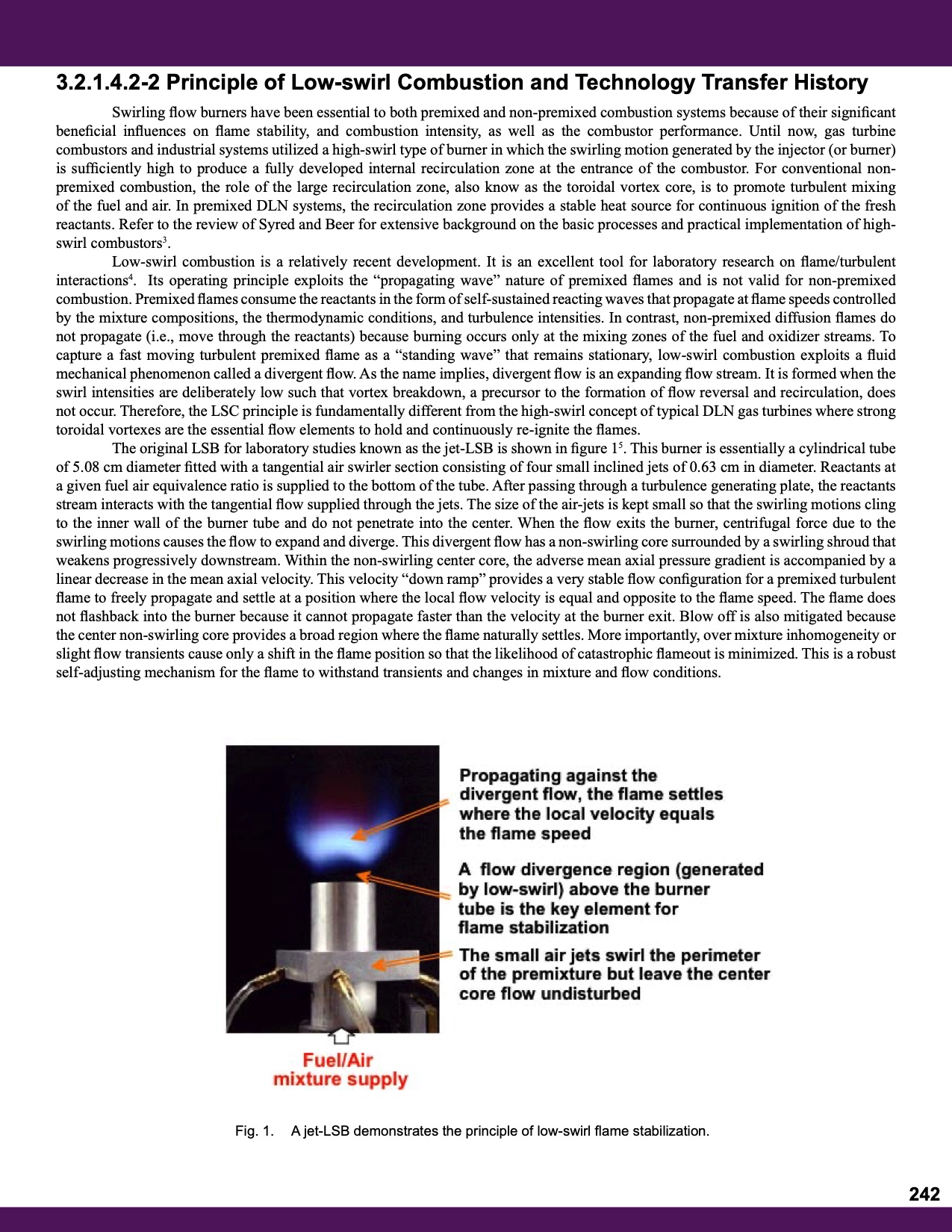
The original LSB for laboratory studies known as the jet-LSB is shown in figure 15. This burner is essentially a cylindrical tube
of 5.08 cm diameter fitted with a tangential air swirler section consisting of four small inclined jets of 0.63 cm in diameter. Reactants at
a given fuel air equivalence ratio is supplied to the bottom of the tube. After passing through a turbulence generating plate, the reactants
stream interacts with the tangential flow supplied through the jets. The size of the air-jets is kept small so that the swirling motions cling
to the inner wall of the burner tube and do not penetrate into the center. When the flow exits the burner, centrifugal force due to the
swirling motions causes the flow to expand and diverge. This divergent flow has a non-swirling core surrounded by a swirling shroud that
weakens progressively downstream. Within the non-swirling center core, the adverse mean axial pressure gradient is accompanied by a
linear decrease in the mean axial velocity. This velocity “down ramp” provides a very stable flow configuration for a premixed turbulent
flame to freely propagate and settle at a position where the local flow velocity is equal and opposite to the flame speed. The flame does
not flashback into the burner because it cannot propagate faster than the velocity at the burner exit. Blow off is also mitigated because
the center non-swirling core provides a broad region where the flame naturally settles. More importantly, over mixture inhomogeneity or
slight flow transients cause only a shift in the flame position so that the likelihood of catastrophic flameout is minimized. This is a robust
self-adjusting mechanism for the flame to withstand transients and changes in mixture and flow conditions.
Fig. 1. A jet-LSB demonstrates the principle of low-swirl flame stabilization.
242 |
