Search Gas Turbine Power for Data Center Publications search was updated real-time via Filemaker on:
Page | 010 4.4 Heat Transfer Analysis
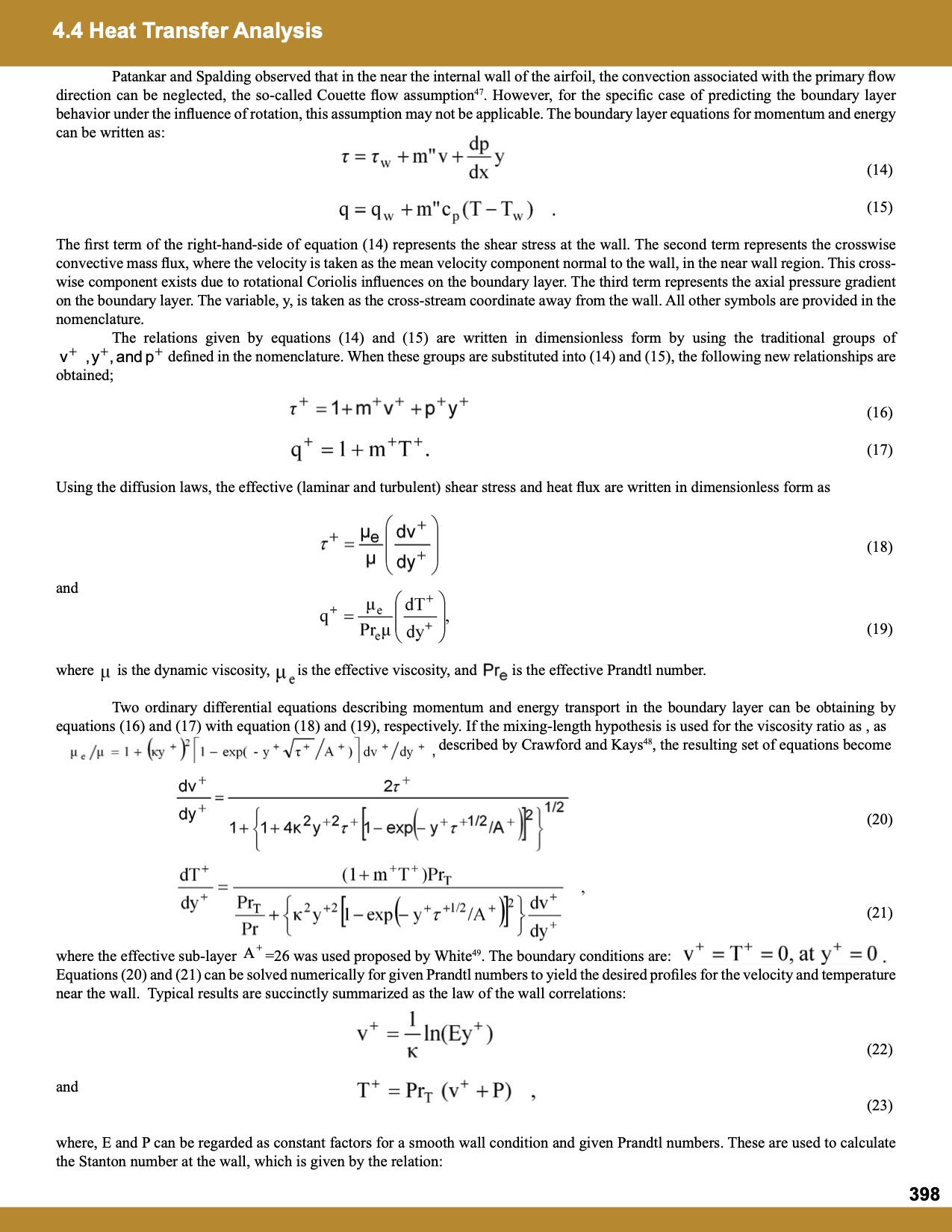
Patankar and Spalding observed that in the near the internal wall of the airfoil, the convection associated with the primary flow
direction can be neglected, the so-called Couette flow assumption47. However, for the specific case of predicting the boundary layer
behavior under the influence of rotation, this assumption may not be applicable. The boundary layer equations for momentum and energy
can be written as:
(14)
(15)
The first term of the right-hand-side of equation (14) represents the shear stress at the wall. The second term represents the crosswise
convective mass flux, where the velocity is taken as the mean velocity component normal to the wall, in the near wall region. This cross-
wise component exists due to rotational Coriolis influences on the boundary layer. The third term represents the axial pressure gradient
on the boundary layer. The variable, y, is taken as the cross-stream coordinate away from the wall. All other symbols are provided in the
nomenclature.
The relations given by equations (14) and (15) are written in dimensionless form by using the traditional groups of
+
v defined in the nomenclature. When these groups are substituted into (14) and (15), the following new relationships are
+ p
,
y
and
+
,
obtained;
(16)
(17)
Using the diffusion laws, the effective (laminar and turbulent) shear stress and heat flux are written in dimensionless form as
(18)
and
(19)
where is the dynamic viscosity, is the effective viscosity, and is the effective Prandtl number.
Two ordinary differential equations describing momentum and energy transport in the boundary layer can be obtaining by
equations (16) and (17) with equation (18) and (19), respectively. If the mixing-length hypothesis is used for the viscosity ratio as , as
described by Crawford and Kays48, the resulting set of equations become
(20)
(21)
where the effective sub-layer +
A =26 was used proposed by White49. The boundary conditions are:
Equations (20) and (21) can be solved numerically for given Prandtl numbers to yield the desired profiles for the velocity and temperature
near the wall. Typical results are succinctly summarized as the law of the wall correlations:
(22)
and
(23)
where, E and P can be regarded as constant factors for a smooth wall condition and given Prandtl numbers. These are used to calculate
the Stanton number at the wall, which is given by the relation:
398 |
