Search Gas Turbine Power for Data Center Publications search was updated real-time via Filemaker on:
Page | 006 4.4 Heat Transfer Analysis
Pattern Factor =
(5)
Profile Factor =
(6)
.
For the first vane, the peak temperature is obtained from pattern factor and this information is used for thermal-mechanical
design. It should be noted current combustor exit temperatures are in excess of 3000°F (1650°C) with expected growth towards 3800°F
(2100°C). As the flow passes through the turbine components, the temperature profile retains the same basic form of the high temperature
in the center region and lower temperature at the outside region, but it is also affected by the processes that take place during turbine
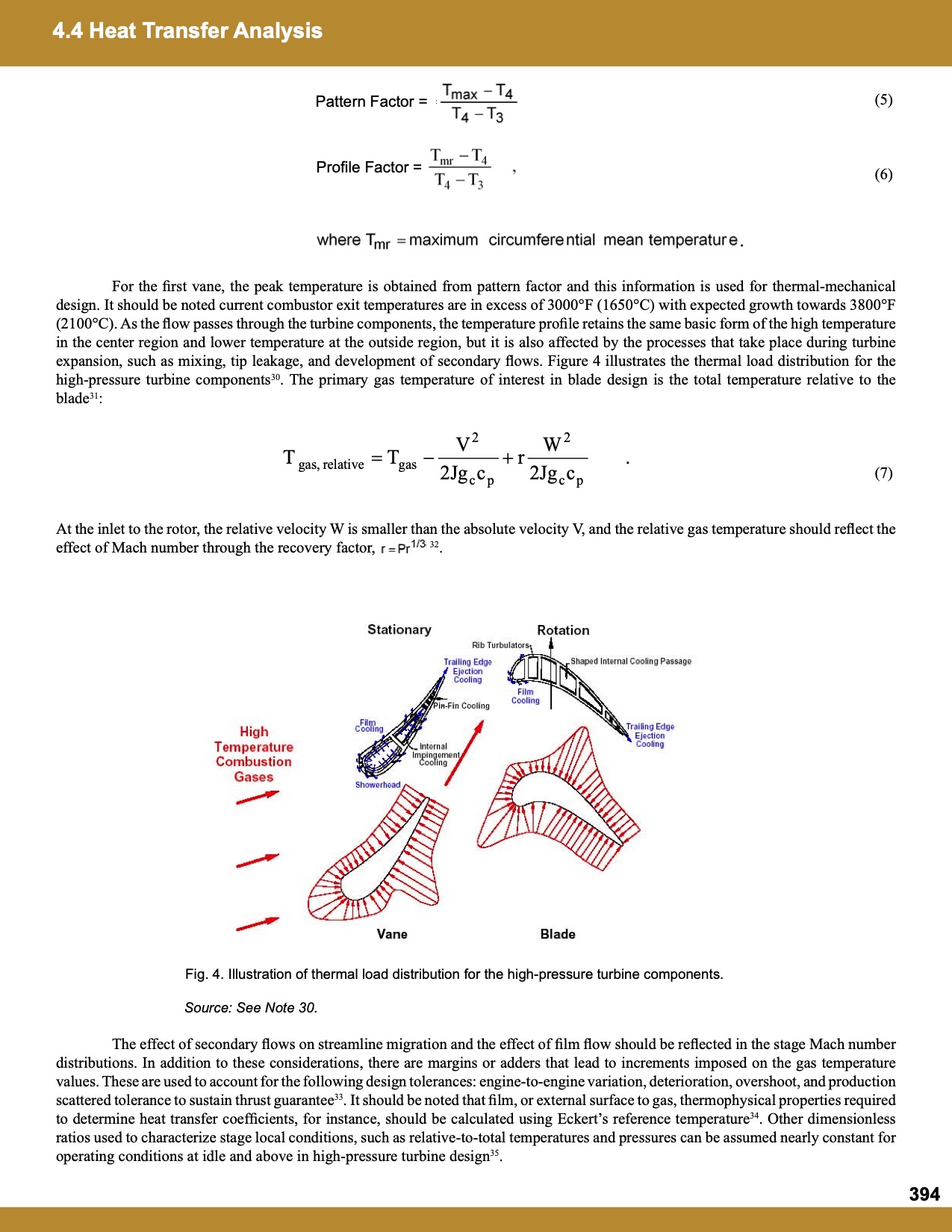
expansion, such as mixing, tip leakage, and development of secondary flows. Figure 4 illustrates the thermal load distribution for the
high-pressure turbine components30. The primary gas temperature of interest in blade design is the total temperature relative to the
blade31:
T
2
V
=
T
−
gas, +
relative
gas
2Jg
c
c
p
2
W
r
.
2Jg
c
c
p
(7)
At the inlet to the rotor, the relative velocity W is smaller than the absolute velocity V, and the relative gas temperature should reflect the
effect of Mach number through the recovery factor, 32
.
Fig. 4. Illustration of thermal load distribution for the high-pressure turbine components.
Source: See Note 30.
The effect of secondary flows on streamline migration and the effect of film flow should be reflected in the stage Mach number
distributions. In addition to these considerations, there are margins or adders that lead to increments imposed on the gas temperature
values. These are used to account for the following design tolerances: engine-to-engine variation, deterioration, overshoot, and production
scattered tolerance to sustain thrust guarantee33. It should be noted that film, or external surface to gas, thermophysical properties required
to determine heat transfer coefficients, for instance, should be calculated using Eckert’s reference temperature34. Other dimensionless
ratios used to characterize stage local conditions, such as relative-to-total temperatures and pressures can be assumed nearly constant for
operating conditions at idle and above in high-pressure turbine design35
.
394 |
