Search Gas Turbine Power for Data Center Publications search was updated real-time via Filemaker on:
Search Completed | Title | GE Power Heavy-Duty Gas Turbine Operating and Maintenance Considerations GER-362OP
Original File Name Searched: 20210911093317_93385.pdf | Google It | Yahoo | Bing
Page | 011 shown in Figure 7, influences such as fuel type and quality, firing
temperature setting, and the amount of steam or water injection
are considered with regard to the hours-based criteria. Startup rate
and the number of trips are considered with regard to the starts-
based criteria. In both cases, these influences may reduce the
maintenance intervals.
Typical baseline inspection intervals (6B.03/7E.03):
Hot gas path inspection 24,000 hrs or 1200 starts
Major inspection 48,000 hrs or 2400 starts
Criterion is hours or starts (whichever occurs first)
Factors affecting maintenance:
Hours-Based Factors
•
•
Fuel type
Peak load
•
Diluent (water or steam injection)
Starts-Based Factors
•
•
•
Start type (conventional or peaking-fast)
Start load (max. load achieved during start cycle, e.g.
part, base, or peak load)
Shutdown type (normal cooldown, rapid cooldown, or trip)
Figure 7. Maintenance factors
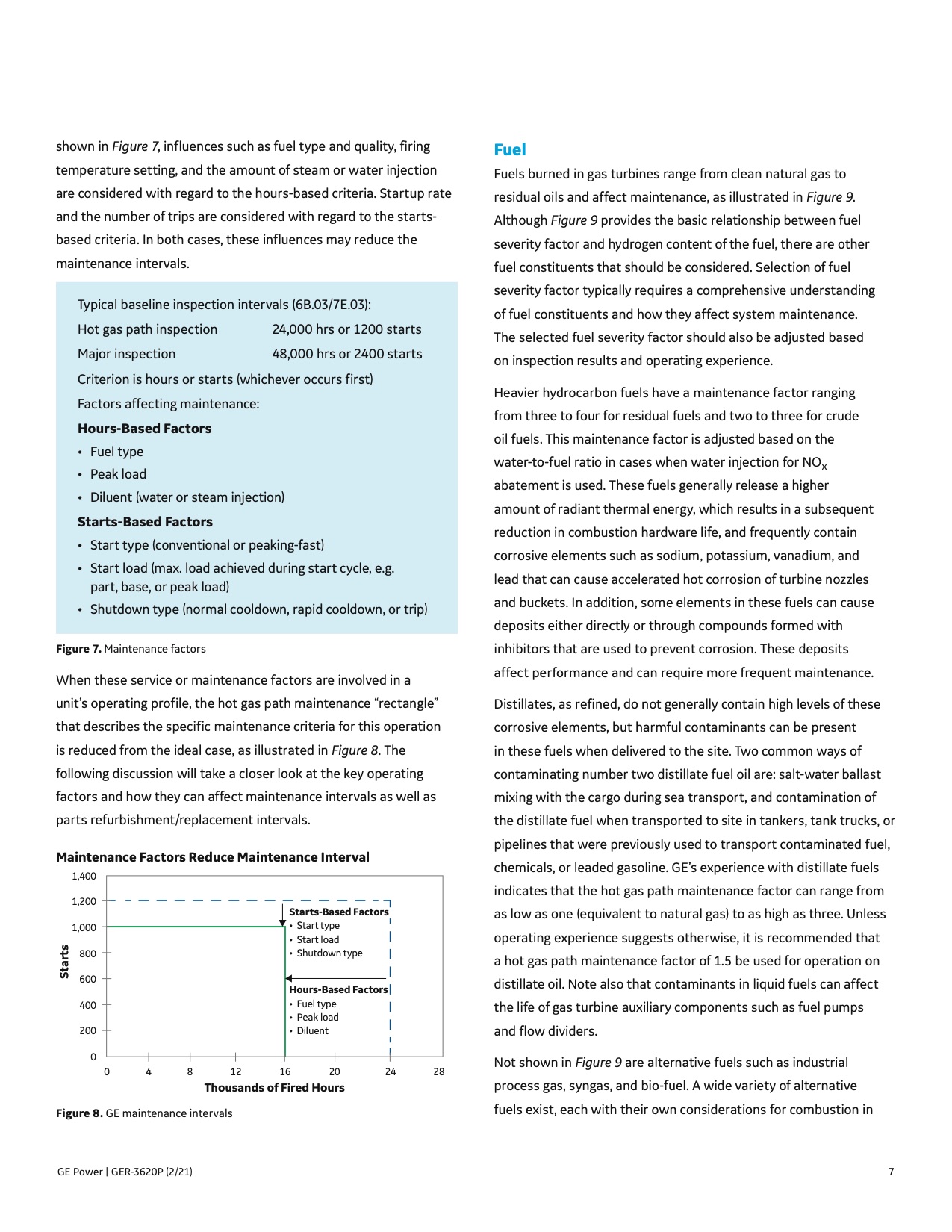
When these service or maintenance factors are involved in a
unit’s operating profile, the hot gas path maintenance “rectangle”
that describes the specific maintenance criteria for this operation
is reduced from the ideal case, as illustrated in Figure 8. The
following discussion will take a closer look at the key operating
factors and how they can affect maintenance intervals as well as
parts refurbishment/replacement intervals.
Maintenance Factors Reduce Maintenance Interval
1,400
1,200
1,000
Starts
800
600
400
200
Hours-Based Factors
• Fuel type
• Peak load
• Diluent
0
0 20 24 28
4 8 12 16
Thousands of Fired Hours
Figure 8. GE maintenance intervals
Starts-Based Factors
• Start type
• Start load
• Shutdown type
Fuel
Fuels burned in gas turbines range from clean natural gas to
residual oils and affect maintenance, as illustrated in Figure 9.
Although Figure 9 provides the basic relationship between fuel
severity factor and hydrogen content of the fuel, there are other
fuel constituents that should be considered. Selection of fuel
severity factor typically requires a comprehensive understanding
of fuel constituents and how they affect system maintenance.
The selected fuel severity factor should also be adjusted based
on inspection results and operating experience.
Heavier hydrocarbon fuels have a maintenance factor ranging
from three to four for residual fuels and two to three for crude
oil fuels. This maintenance factor is adjusted based on the
water-to-fuel ratio in cases when water injection for NOx
abatement is used. These fuels generally release a higher
amount of radiant thermal energy, which results in a subsequent
reduction in combustion hardware life, and frequently contain
corrosive elements such as sodium, potassium, vanadium, and
lead that can cause accelerated hot corrosion of turbine nozzles
and buckets. In addition, some elements in these fuels can cause
deposits either directly or through compounds formed with
inhibitors that are used to prevent corrosion. These deposits
affect performance and can require more frequent maintenance.
Distillates, as refined, do not generally contain high levels of these
corrosive elements, but harmful contaminants can be present
in these fuels when delivered to the site. Two common ways of
contaminating number two distillate fuel oil are: salt-water ballast
mixing with the cargo during sea transport, and contamination of
the distillate fuel when transported to site in tankers, tank trucks, or
pipelines that were previously used to transport contaminated fuel,
chemicals, or leaded gasoline. GE’s experience with distillate fuels
indicates that the hot gas path maintenance factor can range from
as low as one (equivalent to natural gas) to as high as three. Unless
operating experience suggests otherwise, it is recommended that
a hot gas path maintenance factor of 1.5 be used for operation on
distillate oil. Note also that contaminants in liquid fuels can affect
the life of gas turbine auxiliary components such as fuel pumps
and flow dividers.
Not shown in Figure 9 are alternative fuels such as industrial
process gas, syngas, and bio-fuel. A wide variety of alternative
fuels exist, each with their own considerations for combustion in
GE Power | GER-3620P (2/21) 7 |
