Search Gas Turbine Power for Data Center Publications search was updated real-time via Filemaker on:
Search Completed | Title | Enhanced Internal Cooling of Turbine Blades and Vanes
Original File Name Searched: 4-2-2-2.pdf | Google It | Yahoo | Bing
Page | 001 4.2.2.2
Enhanced Internal Cooling
of Turbine Blades and Vanes
Je-Chin Han
Lesley M. Wright
Turbine Heat Transfer Laboratory
Department of Mechanical
Engineering
Texas A&M University
College Station, Texas 77843-3123,
USA
email: jc-han@tamu.edu
321 321
4.2.2.2-1 Introduction
Gas turbines play a vital role in the today’s industrialized society, and as the
demands for power increase, the power output and thermal effi ciency of gas turbines
must also increase. One method of increasing both the power output and thermal
effi ciency of the engine is to increase the temperature of the gas entering the turbine.
In the advanced gas turbines of today, the turbine inlet temperature can be as high
as 1500°C; however, this temperature exceeds the melting temperature of the metal
airfoils. Therefore, it is imperative that the blades and vanes are cooled, so they can
withstand these extreme temperatures. Cooling air around 650°C is extracted from
the compressor and passes through the airfoils. With the hot gases and cooling air,
the temperature of the blades can be lowered to approximately 1000°C, which is
permissible for reliable operation of the engine.
It is widely accepted that the life of a turbine blade can be reduced by half if
the temperature prediction of the metal blade is off by only 30°C. In order to avoid
premature failure, designers must accurately predict the local heat transfer coeffi cients
and local airfoil metal temperatures. By preventing local hot spots, the life of the
turbine blades and vanes will increase. However, due to the complex fl ow around
the airfoils it is diffi cult for designers to accurately predict the metal temperature.
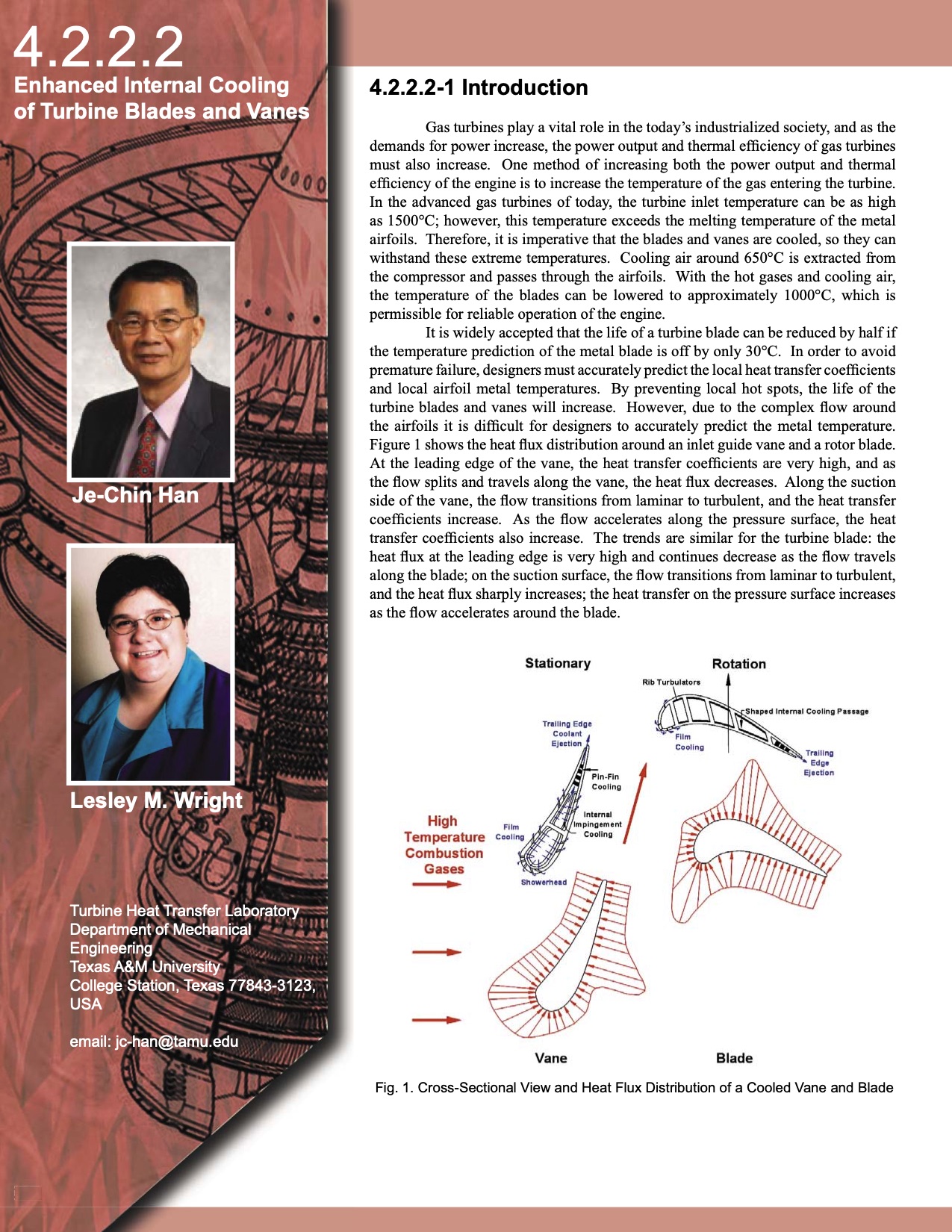
Figure 1 shows the heat fl ux distribution around an inlet guide vane and a rotor blade.
At the leading edge of the vane, the heat transfer coeffi cients are very high, and as
the fl ow splits and travels along the vane, the heat fl ux decreases. Along the suction
side of the vane, the fl ow transitions from laminar to turbulent, and the heat transfer
coeffi cients increase. As the fl ow accelerates along the pressure surface, the heat
transfer coeffi cients also increase. The trends are similar for the turbine blade: the
heat fl ux at the leading edge is very high and continues decrease as the fl ow travels
along the blade; on the suction surface, the fl ow transitions from laminar to turbulent,
and the heat fl ux sharply increases; the heat transfer on the pressure surface increases
as the fl ow accelerates around the blade.
Fig. 1. Cross-Sectional View and Heat Flux Distribution of a Cooled Vane and Blade |
