Search Gas Turbine Power for Data Center Publications search was updated real-time via Filemaker on:
Search Completed | Title | Different Types of Gasifiers and Their Integration with Gas Turbines
Original File Name Searched: 1-2-1.pdf | Google It | Yahoo | Bing
Page | 001 1.2.1
Different Types of Gasifi ers
and Their Integration with
Gas Turbines
Jeffrey Phillips
EPRI / Advanced Coal Generation
P.O. Box 217097
Charlotte, NC 28221
phone: (704) 595-2250
email: jphillip@epri.com
67 67
1.2.1-1 Introduction
What is gasifi cation?
Gasifi cation is a process in which combustible materials are partially oxi-
dized or partially combusted. The product of gasifi cation is a combustible synthesis
gas, or syngas. Because gasifi cation involves the partial, rather than complete, oxi-
dization of the feed, gasifi cation processes operate in an oxygen-lean environment.
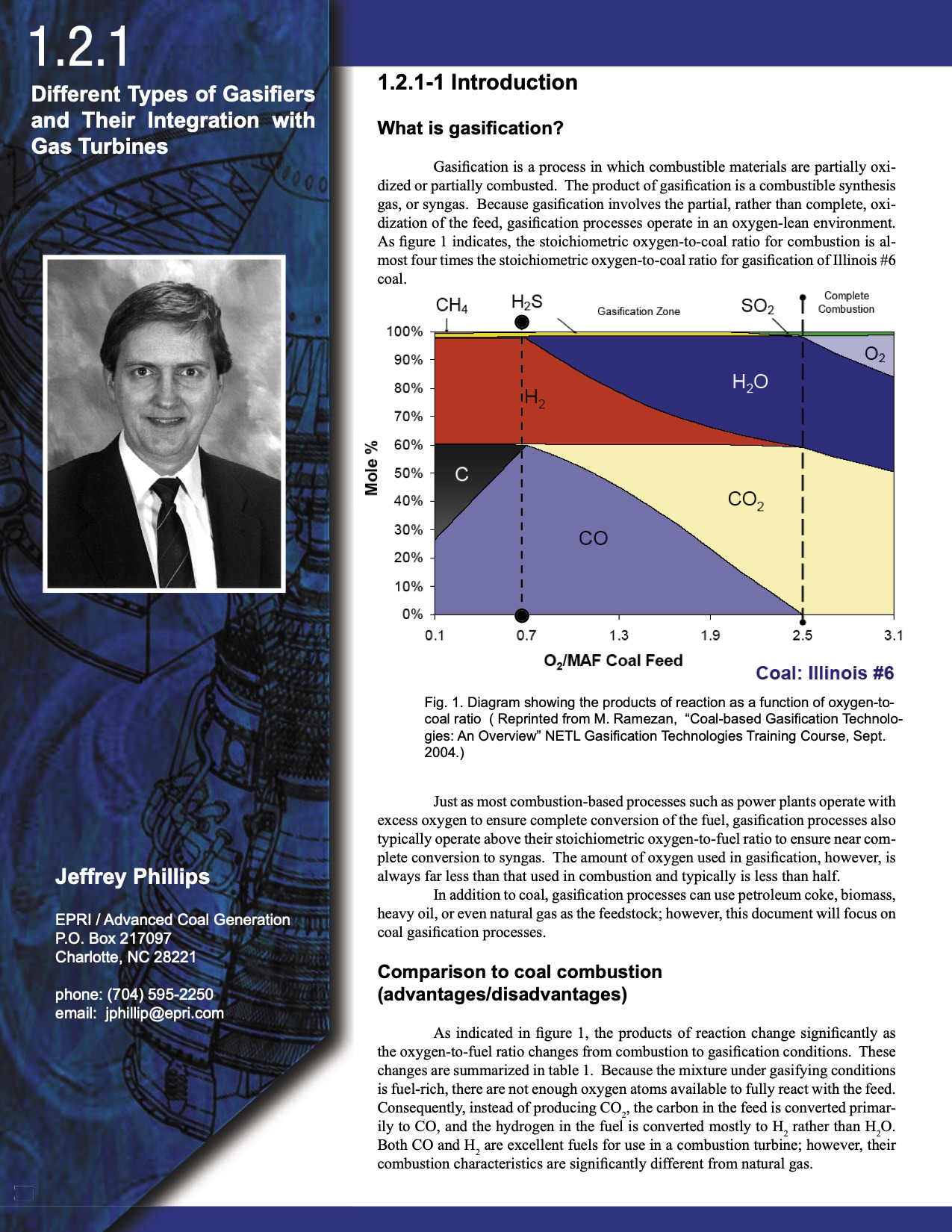
As fi gure 1 indicates, the stoichiometric oxygen-to-coal ratio for combustion is al-
most four times the stoichiometric oxygen-to-coal ratio for gasifi cation of Illinois #6
coal.
Fig. 1. Diagram showing the products of reaction as a function of oxygen-to-
coal ratio ( Reprinted from M. Ramezan, “Coal-based Gasifi cation Technolo-
gies: An Overview” NETL Gasifi cation Technologies Training Course, Sept.
2004.)
Just as most combustion-based processes such as power plants operate with
excess oxygen to ensure complete conversion of the fuel, gasifi cation processes also
typically operate above their stoichiometric oxygen-to-fuel ratio to ensure near com-
plete conversion to syngas. The amount of oxygen used in gasifi cation, however, is
always far less than that used in combustion and typically is less than half.
In addition to coal, gasifi cation processes can use petroleum coke, biomass,
heavy oil, or even natural gas as the feedstock; however, this document will focus on
coal gasifi cation processes.
Comparison to coal combustion
(advantages/disadvantages)
As indicated in fi gure 1, the products of reaction change signifi cantly as
the oxygen-to-fuel ratio changes from combustion to gasifi cation conditions. These
changes are summarized in table 1. Because the mixture under gasifying conditions
is fuel-rich, there are not enough oxygen atoms available to fully react with the feed.
Consequently, instead of producing CO2, the carbon in the feed is converted primar-
ily to CO, and the hydrogen in the fuel is converted mostly to H2 rather than H2O.
Both CO and H2 are excellent fuels for use in a combustion turbine; however, their
combustion characteristics are signifi cantly different from natural gas. |
