Search Gas Turbine Power for Data Center Publications search was updated real-time via Filemaker on:
Page | 001 3.2.1.1
Conventional Type
Combustion
Scott Samuelsen
Professor of Mechanical, Aerospace,
and Environmental Engineering
Director
Advanced Power and Energy Program
University of California
Irvine
92697-3550
phone: 949-824-5468
email: gss@uci.edu
209 209
3.2.1.1-1 Introduction
Brayton Cycle
The role of the combustor in a gas turbine engine is two-fold. First, the
combustor transforms the chemical energy resident in the fuel into thermal energy
for expansion in the turbine. Second, the combustor tailors the temperature profi le
of the hot gases at the exit plane in order to not compromise the material constraints
of the turbine. To fulfi ll this two-fold role, the combustor is designed to mix fuel
with air at elevated pressure and temperature, to both establish and sustain a stable
continuous combustion reaction, and to mix the products of combustion to establish
the desired exhaust temperature profi le. The combustor processes are, as a result,
a complex combination of fl uid mixing, chemical kinetics, and heat transfer. To
contain and control these processes, the design of the “conventional” combustor has
evolved over seven decades for the production of propulsive thrust and electrical
power.
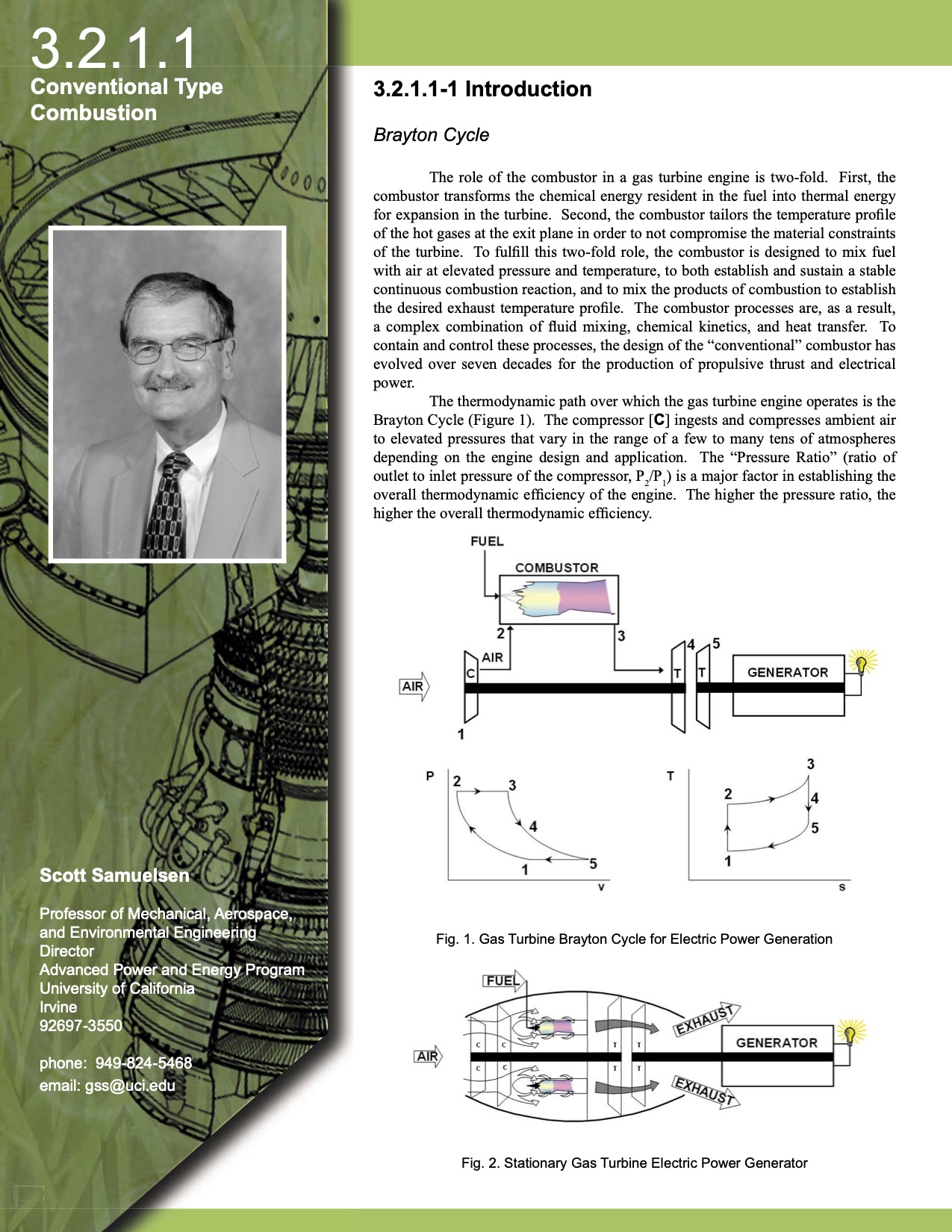
The thermodynamic path over which the gas turbine engine operates is the
Brayton Cycle (Figure 1). The compressor [C] ingests and compresses ambient air
to elevated pressures that vary in the range of a few to many tens of atmospheres
depending on the engine design and application. The “Pressure Ratio” (ratio of
outlet to inlet pressure of the compressor, P2/P1) is a major factor in establishing the
overall thermodynamic effi ciency of the engine. The higher the pressure ratio, the
higher the overall thermodynamic effi ciency.
Fig. 1. Gas Turbine Brayton Cycle for Electric Power Generation
Fig. 2. Stationary Gas Turbine Electric Power Generator |
