Search Gas Turbine Power for Data Center Publications search was updated real-time via Filemaker on:
Search Completed | Title | Applying Natural Gas Engine Generators to Hyperscale Data Centers
Original File Name Searched: WP286V1.pdf | Google It | Yahoo | Bing
Page | 015 Schneider Electric – Data Center Science Center White Paper 286 Version 1 15
Reliability comparison
The reliability and availability study presented in this paper aims to show the differ-
ence between a traditional architecture with a diesel standby generator power plant
and the new architecture with a continuous gas generation power plant, as shown in
Figure 8. Ensuring high reliability and availability of the server power supplies is the
key objective for the data centre’s physical infrastructure systems:
• reliability refers to the probability of not having a failure in the supply of power
to any IT rack during a given period of time;
• availability refers to the percentage of time the IT racks are powered
Since even the briefest of outages can have severe effects on the business, custom-
ers usually define their reliability target as “no risk of power supply failures”. There-
fore, the customer target is usually more related to reliability rather than to availabil-
ity. However, some customers hosting their IT process across several data centres
are able to handle a single data centre shutdown. They tend to be more interested in
the availability of each of their data centres. These customers can formulate their
target as “data center availability > 99,999%” (or in the “number of nines”). Consid-
ering these customer inputs, the computed reliability and availability indexes are:
• the mean failure2 frequency (estimated number of failures per year) which re-
flects the reliability of the data center infrastructure,
• and the mean unavailability (estimated percentage of the time where the data
centre is unavailable).
The study is focused on all the equipment from the power sources to the MV switch-
boards of each block including:
• The grid supply
• The HV and MV electrical switchgear, the MV protection relays and the auxil-
iary power supply
• The generators including the engine, alternator, control panel, and cooling
• All auxiliary systems, including the fuel supply system, automation, reagent
supply system, and the auxiliary power supply
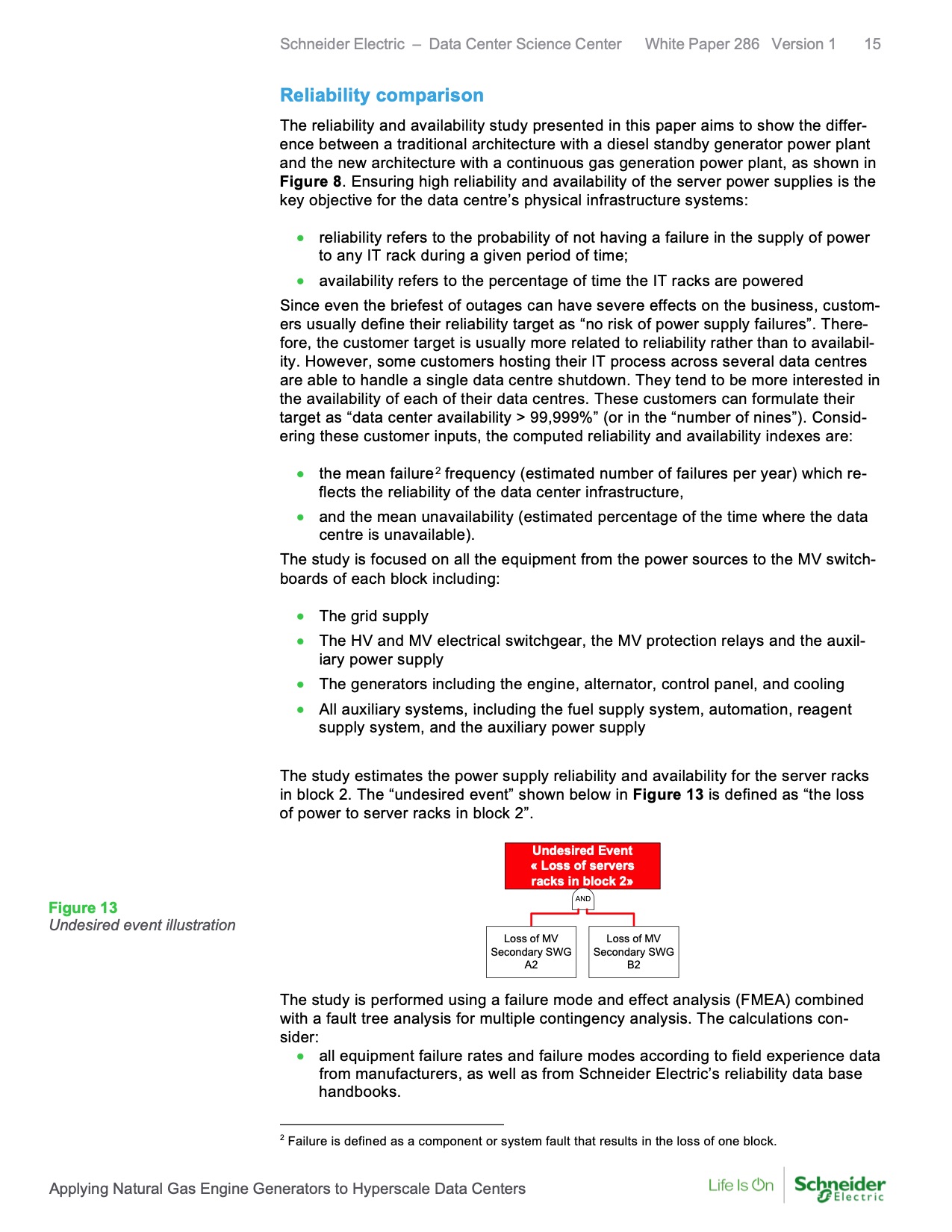
The study estimates the power supply reliability and availability for the server racks
in block 2. The “undesired event” shown below in Figure 13 is defined as “the loss
of power to server racks in block 2”.
Undesired Event
« Loss of servers
racks in block 2»
AND
Figure 13
Undesired event illustration
Loss of MV
Secondary SWG
A2
Loss of MV
Secondary SWG
B2
The study is performed using a failure mode and effect analysis (FMEA) combined
with a fault tree analysis for multiple contingency analysis. The calculations con-
sider:
• all equipment failure rates and failure modes according to field experience data
from manufacturers, as well as from Schneider Electric’s reliability data base
handbooks.
2 Failure is defined as a component or system fault that results in the loss of one block.
Applying Natural Gas Engine Generators to Hyperscale Data Centers |
