Search Gas Turbine Power for Data Center Publications search was updated real-time via Filemaker on:
Search Completed | Title | Applying Natural Gas Engine Generators to Hyperscale Data Centers
Original File Name Searched: WP286V1.pdf | Google It | Yahoo | Bing
Page | 007 Schneider Electric – Data Center Science Center White Paper 286 Version 1 7
Set of gas generators
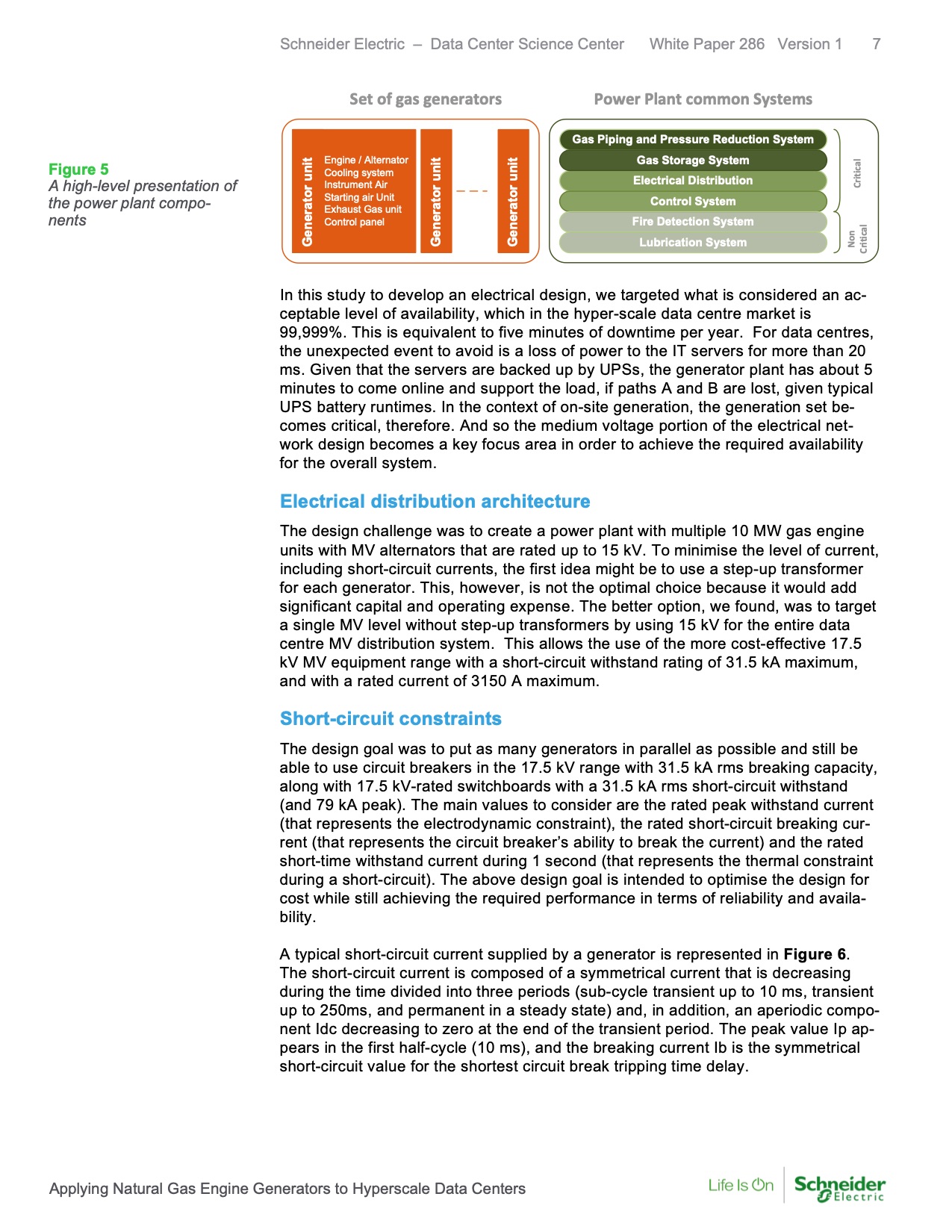
Figure 5
A high-level presentation of
the power plant compo-
nents
• Engine / Alternator
• Cooling system
• Instrument Air
• Starting air Unit
• Exhaust Gas unit
• Control panel
Generator unit
Generator unit
Generator unit
Power Plant common Systems
Gas Piping and Pressure Reduction System
Gas Storage System
Electrical Distribution
Control System
Fire Detection System
Lubrication System
Critical
Non
Critical
In this study to develop an electrical design, we targeted what is considered an ac-
ceptable level of availability, which in the hyper-scale data centre market is
99,999%. This is equivalent to five minutes of downtime per year. For data centres,
the unexpected event to avoid is a loss of power to the IT servers for more than 20
ms. Given that the servers are backed up by UPSs, the generator plant has about 5
minutes to come online and support the load, if paths A and B are lost, given typical
UPS battery runtimes. In the context of on-site generation, the generation set be-
comes critical, therefore. And so the medium voltage portion of the electrical net-
work design becomes a key focus area in order to achieve the required availability
for the overall system.
Electrical distribution architecture
The design challenge was to create a power plant with multiple 10 MW gas engine
units with MV alternators that are rated up to 15 kV. To minimise the level of current,
including short-circuit currents, the first idea might be to use a step-up transformer
for each generator. This, however, is not the optimal choice because it would add
significant capital and operating expense. The better option, we found, was to target
a single MV level without step-up transformers by using 15 kV for the entire data
centre MV distribution system. This allows the use of the more cost-effective 17.5
kV MV equipment range with a short-circuit withstand rating of 31.5 kA maximum,
and with a rated current of 3150 A maximum.
Short-circuit constraints
The design goal was to put as many generators in parallel as possible and still be
able to use circuit breakers in the 17.5 kV range with 31.5 kA rms breaking capacity,
along with 17.5 kV-rated switchboards with a 31.5 kA rms short-circuit withstand
(and 79 kA peak). The main values to consider are the rated peak withstand current
(that represents the electrodynamic constraint), the rated short-circuit breaking cur-
rent (that represents the circuit breaker’s ability to break the current) and the rated
short-time withstand current during 1 second (that represents the thermal constraint
during a short-circuit). The above design goal is intended to optimise the design for
cost while still achieving the required performance in terms of reliability and availa-
bility.
A typical short-circuit current supplied by a generator is represented in Figure 6.
The short-circuit current is composed of a symmetrical current that is decreasing
during the time divided into three periods (sub-cycle transient up to 10 ms, transient
up to 250ms, and permanent in a steady state) and, in addition, an aperiodic compo-
nent Idc decreasing to zero at the end of the transient period. The peak value Ip ap-
pears in the first half-cycle (10 ms), and the breaking current Ib is the symmetrical
short-circuit value for the shortest circuit break tripping time delay.
Applying Natural Gas Engine Generators to Hyperscale Data Centers |
