Search Gas Turbine Power for Data Center Publications search was updated real-time via Filemaker on:
Search Completed | Title | Applying Natural Gas Engine Generators to Hyperscale Data Centers
Original File Name Searched: WP286V1.pdf | Google It | Yahoo | Bing
Page | 002 Schneider Electric – Data Center Science Center White Paper 286 Version 1 2
Introduction
The gas engine generation plant described in this paper is based on current state-
of-the-art, medium-speed, gas-engine technology. During recent years, this technol-
ogy has become more common and applied to increasing numbers of power genera-
tion applications. The reciprocating engines used represent the most efficient simple
cycle power generation technology available today, while at the same time they can
perform extremely fast start-ups and handle sudden load changes. This makes them
suitable for industrial and utility-scale applications, ranging from commercial power
peaker plants to various on-site and off-grid power generation solutions – including
mission-critical data centres. The largest engine power plants currently being sup-
plied have an installed capacity of approximately 600 MW. Given the typical output
of medium-speed gas-engines, they are generally more suited for larger data cen-
tres with a minimum continuous load beyond 10 MW, ideally around 20 MW.
In order to propose an effective data centre design, we must first consider customer
needs such as the facility’s availability requirements, the electrical equipment to be
used, and the chosen electrical distribution architecture. A variety of architectures
could be proposed for large scale data centres to meet availability and reliability re-
quirements. These various architectures rely mainly on the utility as the principle
source feeder with backup generation from a diesel generator power plant, either at
medium voltage (MV) or low voltage (LV) depending on the architecture choices and
the size of the site. This paper will consider N, N+1, and 2N type architectures. De-
pending on the uptime needed, redundant architectures using “2N” or “N+1” redun-
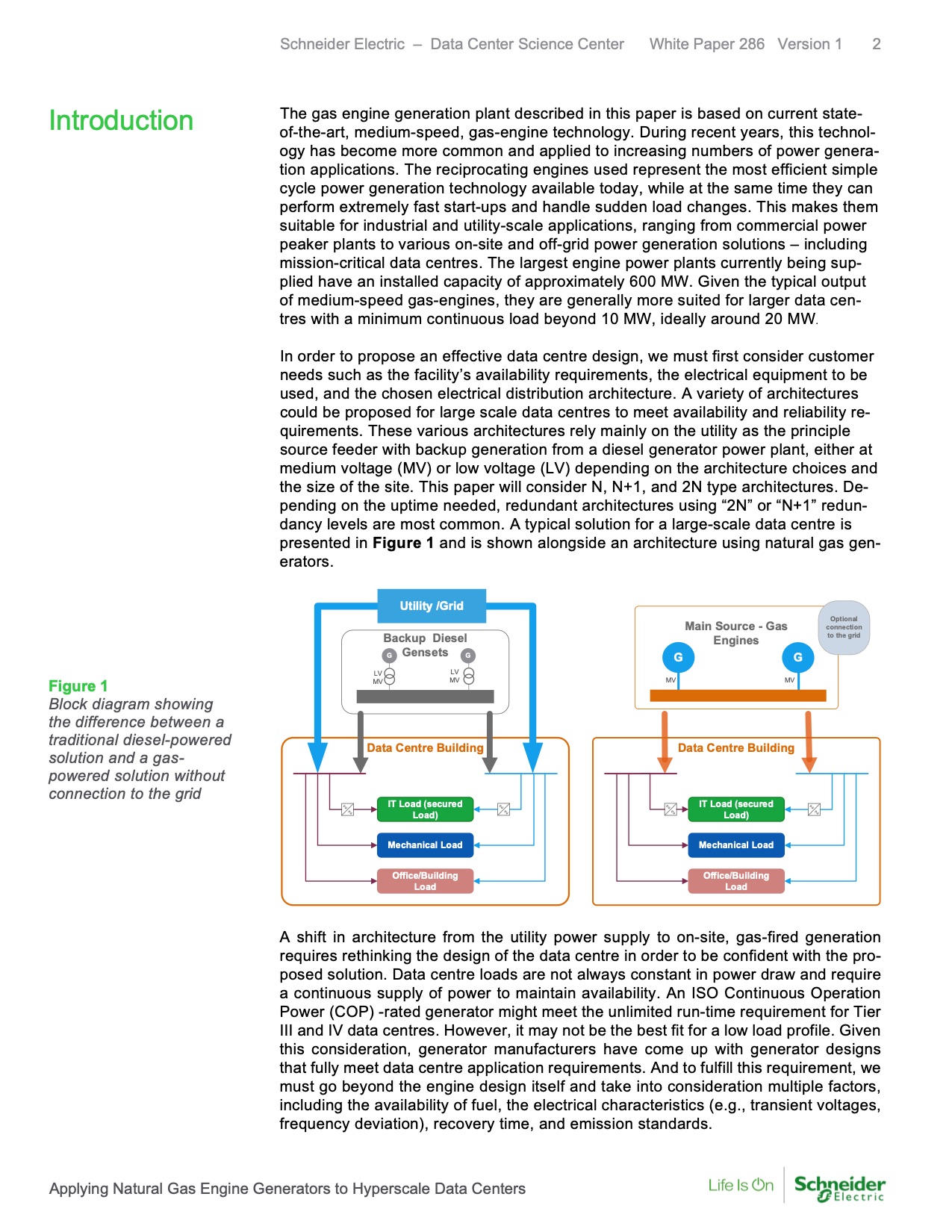
dancy levels are most common. A typical solution for a large-scale data centre is
presented in Figure 1 and is shown alongside an architecture using natural gas gen-
erators.
LV
MV
Utility /Grid
Backup Diesel
Gensets
G G
LV
MV
Main Source - Gas
Engines
Optional
connection
to the grid
G
G
MV MV
Figure 1
Block diagram showing
the difference between a
traditional diesel-powered
solution and a gas-
powered solution without
connection to the grid
Data Centre Building
Data Centre Building
IT Load (secured
Load)
Mechanical Load
Office/Building
Load
IT Load (secured
Load)
Mechanical Load
Office/Building
Load
A shift in architecture from the utility power supply to on-site, gas-fired generation
requires rethinking the design of the data centre in order to be confident with the pro-
posed solution. Data centre loads are not always constant in power draw and require
a continuous supply of power to maintain availability. An ISO Continuous Operation
Power (COP) -rated generator might meet the unlimited run-time requirement for Tier
III and IV data centres. However, it may not be the best fit for a low load profile. Given
this consideration, generator manufacturers have come up with generator designs
that fully meet data centre application requirements. And to fulfill this requirement, we
must go beyond the engine design itself and take into consideration multiple factors,
including the availability of fuel, the electrical characteristics (e.g., transient voltages,
frequency deviation), recovery time, and emission standards.
Applying Natural Gas Engine Generators to Hyperscale Data Centers |
