Search Gas Turbine Power for Data Center Publications search was updated real-time via Filemaker on:
Page | 001 1.3.2
Advanced Brayton Cycles
1.3.2-1 Introduction
Gas turbines could play a key role in the future power generation market
addressing issues of producing clean, effi cient, affordable, and fuel-fl exible electric
power. Numerous projections estimate that gas turbines will comprise a signifi cant
portion of the required generation capacity in the 21st century. Novel advanced gas
turbine cycle modifi cations intended to improve the basic Brayton cycle performance
and reduce pollutant emissions are currently under development or being investigated
by gas turbine manufacturers and Research and Development (R&D) organizations.
Preliminary conceptual analyses of advanced cycles indicate that it may be possible to
achieve an improved combination of effi ciency, emissions, and specifi c power output
which in turn should reduce the power generation equipment cost on a $/kW basis.
Developing turbine technology to operate on coal-derived synthesis gas and
hydrogen is critical to the development of advanced power generation technologies
and the deployment of FutureGen plants. The FutureGen plant concept may also be
deployed in natural gas-based plants with respect to generating power with near-zero
emissions while utilizing these advanced Brayton cycle machines and securing fuel
diversity.
1.3.2-2 Gas Turbine Technology
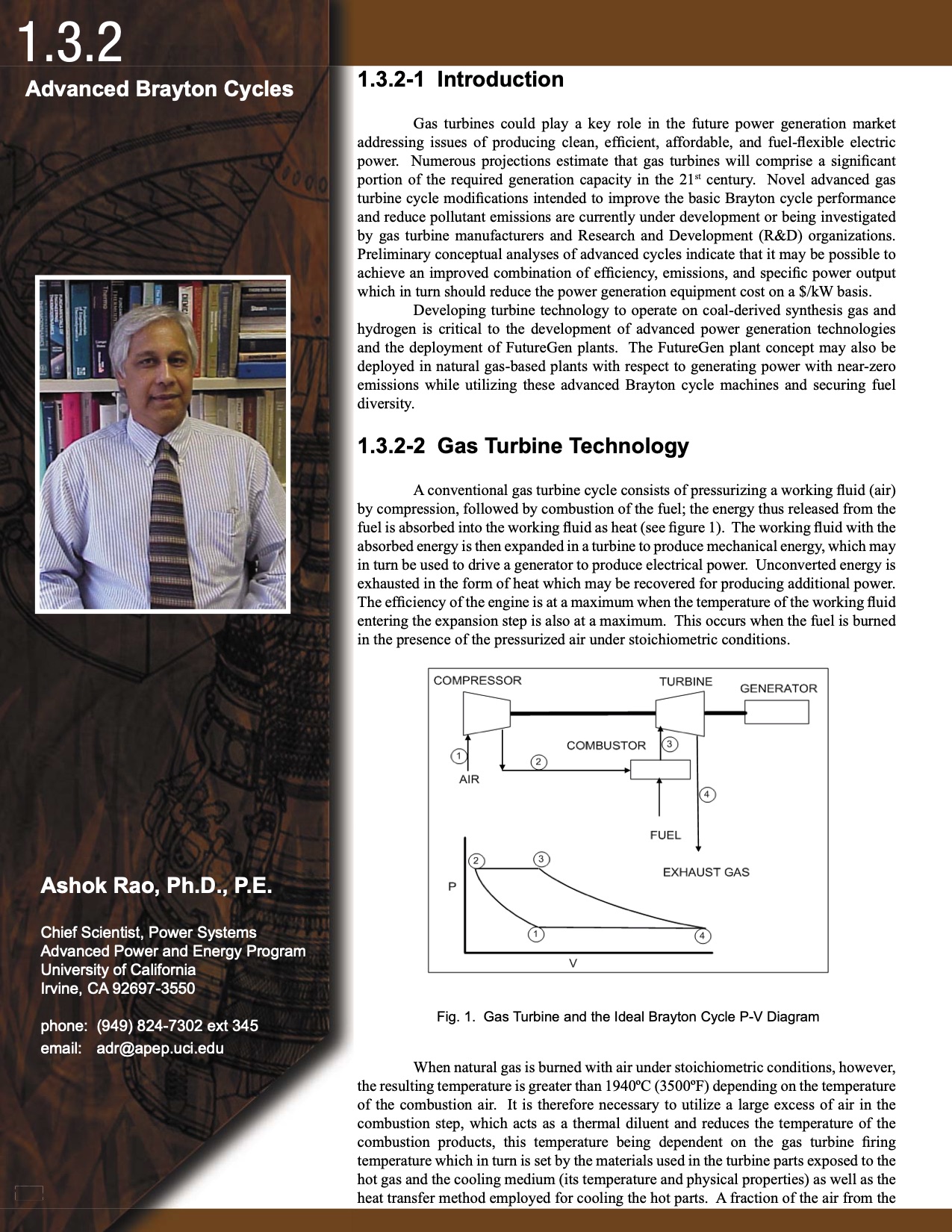
A conventional gas turbine cycle consists of pressurizing a working fl uid (air)
by compression, followed by combustion of the fuel; the energy thus released from the
fuel is absorbed into the working fl uid as heat (see fi gure 1). The working fl uid with the
absorbed energy is then expanded in a turbine to produce mechanical energy, which may
in turn be used to drive a generator to produce electrical power. Unconverted energy is
exhausted in the form of heat which may be recovered for producing additional power.
The effi ciency of the engine is at a maximum when the temperature of the working fl uid
entering the expansion step is also at a maximum. This occurs when the fuel is burned
in the presence of the pressurized air under stoichiometric conditions.
Ashok Rao, Ph.D., P.E.
Chief Scientist, Power Systems
Advanced Power and Energy Program
University of California
Irvine, CA 92697-3550
phone: (949) 824-7302 ext 345
email: adr@apep.uci.edu
Fig. 1. Gas Turbine and the Ideal Brayton Cycle P-V Diagram
115 115
When natural gas is burned with air under stoichiometric conditions, however,
the resulting temperature is greater than 1940ºC (3500ºF) depending on the temperature
of the combustion air. It is therefore necessary to utilize a large excess of air in the
combustion step, which acts as a thermal diluent and reduces the temperature of the
combustion products, this temperature being dependent on the gas turbine fi ring
temperature which in turn is set by the materials used in the turbine parts exposed to the
hot gas and the cooling medium (its temperature and physical properties) as well as the
heat transfer method employed for cooling the hot parts. A fraction of the air from the |
