Search Gas Turbine Power for Data Center Publications search was updated real-time via Filemaker on:
Page | 082 GAS-TURBINE HISTORY
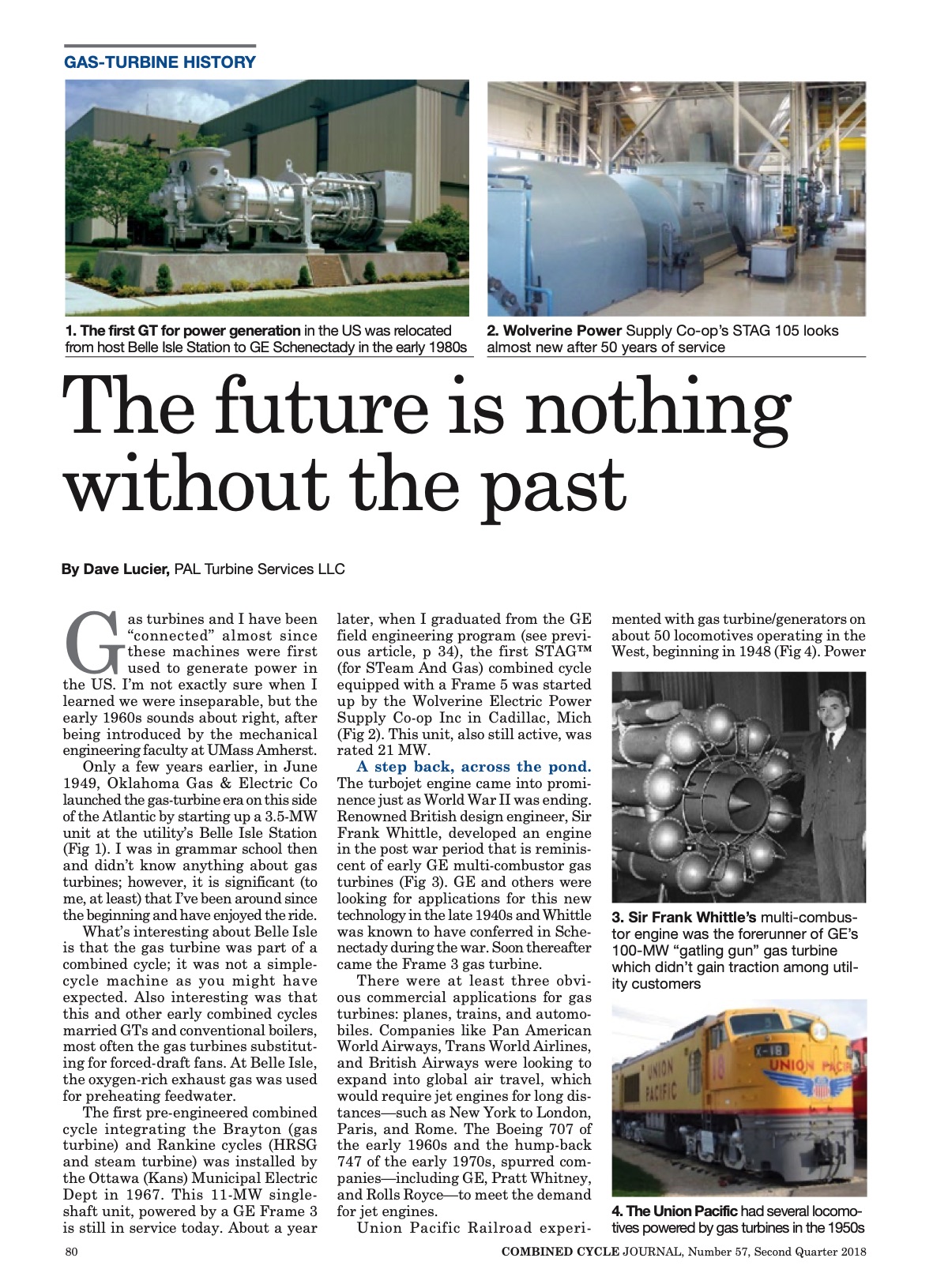
1. The first GT for power generation in the US was relocated
from host Belle Isle Station to GE Schenectady in the early 1980s
2. Wolverine Power Supply Co-op’s STAG 105 looks
almost new after 50 years of service
The future is nothing
without the past
By Dave Lucier, PAL Turbine Services LLC
“connected” almost since
Gas turbines and I have been
these machines were first
used to generate power in
the US. I’m not exactly sure when I
learned we were inseparable, but the
early 1960s sounds about right, after
being introduced by the mechanical
engineering faculty at UMass Amherst.
Only a few years earlier, in June
1949, Oklahoma Gas & Electric Co
launched the gas-turbine era on this side
of the Atlantic by starting up a 3.5-MW
unit at the utility’s Belle Isle Station
(Fig 1). I was in grammar school then
and didn’t know anything about gas
turbines; however, it is significant (to
me, at least) that I’ve been around since
the beginning and have enjoyed the ride.
What’s interesting about Belle Isle
is that the gas turbine was part of a
combined cycle; it was not a simple-
cycle machine as you might have
expected. Also interesting was that
this and other early combined cycles
married GTs and conventional boilers,
most often the gas turbines substitut-
ing for forced-draft fans. At Belle Isle,
the oxygen-rich exhaust gas was used
for preheating feedwater.
The first pre-engineered combined
cycle integrating the Brayton (gas
turbine) and Rankine cycles (HRSG
and steam turbine) was installed by
the Ottawa (Kans) Municipal Electric
Dept in 1967. This 11-MW single-
shaft unit, powered by a GE Frame 3
is still in service today. About a year
later, when I graduated from the GE
field engineering program (see previ-
ous article, p 34), the first STAG™
(for STeam And Gas) combined cycle
equipped with a Frame 5 was started
up by the Wolverine Electric Power
Supply Co-op Inc in Cadillac, Mich
(Fig 2). This unit, also still active, was
rated 21 MW.
A step back, across the pond.
The turbojet engine came into promi-
nence just as World War II was ending.
Renowned British design engineer, Sir
Frank Whittle, developed an engine
in the post war period that is reminis-
cent of early GE multi-combustor gas
turbines (Fig 3). GE and others were
looking for applications for this new
technology in the late 1940s and Whittle
was known to have conferred in Sche-
nectady during the war. Soon thereafter
came the Frame 3 gas turbine.
There were at least three obvi-
ous commercial applications for gas
turbines: planes, trains, and automo-
biles. Companies like Pan American
World Airways, Trans World Airlines,
and British Airways were looking to
expand into global air travel, which
would require jet engines for long dis-
tances—such as New York to London,
Paris, and Rome. The Boeing 707 of
the early 1960s and the hump-back
747 of the early 1970s, spurred com-
panies—including GE, Pratt Whitney,
and Rolls Royce—to meet the demand
for jet engines.
Union Pacific Railroad experi-
mented with gas turbine/generators on
about 50 locomotives operating in the
West, beginning in 1948 (Fig 4). Power
3. Sir Frank Whittle’s multi-combus-
tor engine was the forerunner of GE’s
100-MW “gatling gun” gas turbine
which didn’t gain traction among util-
ity customers
4. The Union Pacific had several locomo-
tives powered by gas turbines in the 1950s
80 COMBINED CYCLE JOURNAL, Number 57, Second Quarter 2018 |
